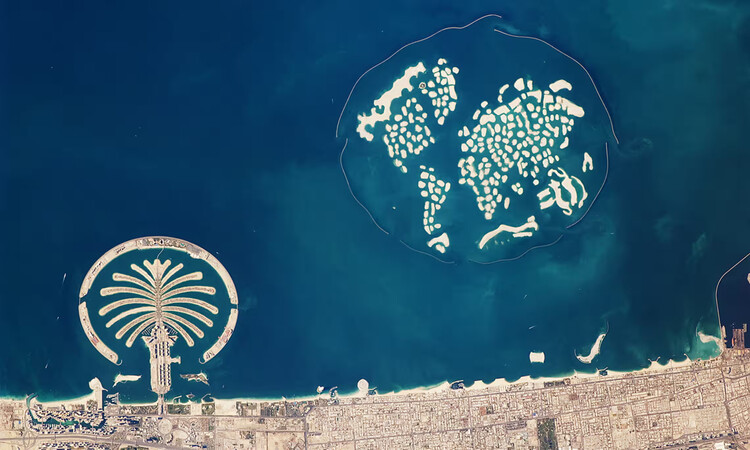
A newly published architectural essay examines how reclaimed land shapes urban design, landscapes, infrastructure, and resilience, using examples including Battery Park City, Governors Island, Shenzhen’s Qianhai, and Dubai’s artificial islands. It offers editorial context on a significant waterfront-planning issue, rather than announcing a new project.
About this story
ArchDaily’s Jonathan Yeung surveys reclaimed land as an engineered surface that depends on fill, seawalls, drainage, soil stabilization, and ongoing maintenance. The article discusses Battery Park City’s creation using fill that included material from the World Trade Center excavation and Hudson River dredging; Governors Island’s raised park landscapes and flood-risk strategy; Shenzhen’s Qianhai; Hainan’s Ocean Flower Island; and Dubai’s Palm Jumeirah and World Islands. It considers the challenges of planting and sustaining public landscapes on manufactured ground, including soil composition, salinity, drainage, groundwater, and flooding. The piece argues that reclaimed land’s apparent freedom from inherited urban constraints comes with long-term ecological and infrastructural obligations. The article is authored by Jonathan Yeung. Its featured image is captioned “The Palm Jumeirah” and credited courtesy of NASA.
Status and timeline
Published by ArchDaily on October 9, 2026; this is an explanatory article about existing places and reclamation practices, not a new project announcement.
Design highlights
Reclaimed ground as an engineered, maintained landscape rather than a blank slate; designed topography and raised root zones as resilience strategies; the relationship between fill, soil quality, water management, public space, and long-term ecological care.